
Products
NEDA is our commercial line of drivers and control electronics for the operation control of optoelectronic components and multi-element photonic integrated circuits (PICs).
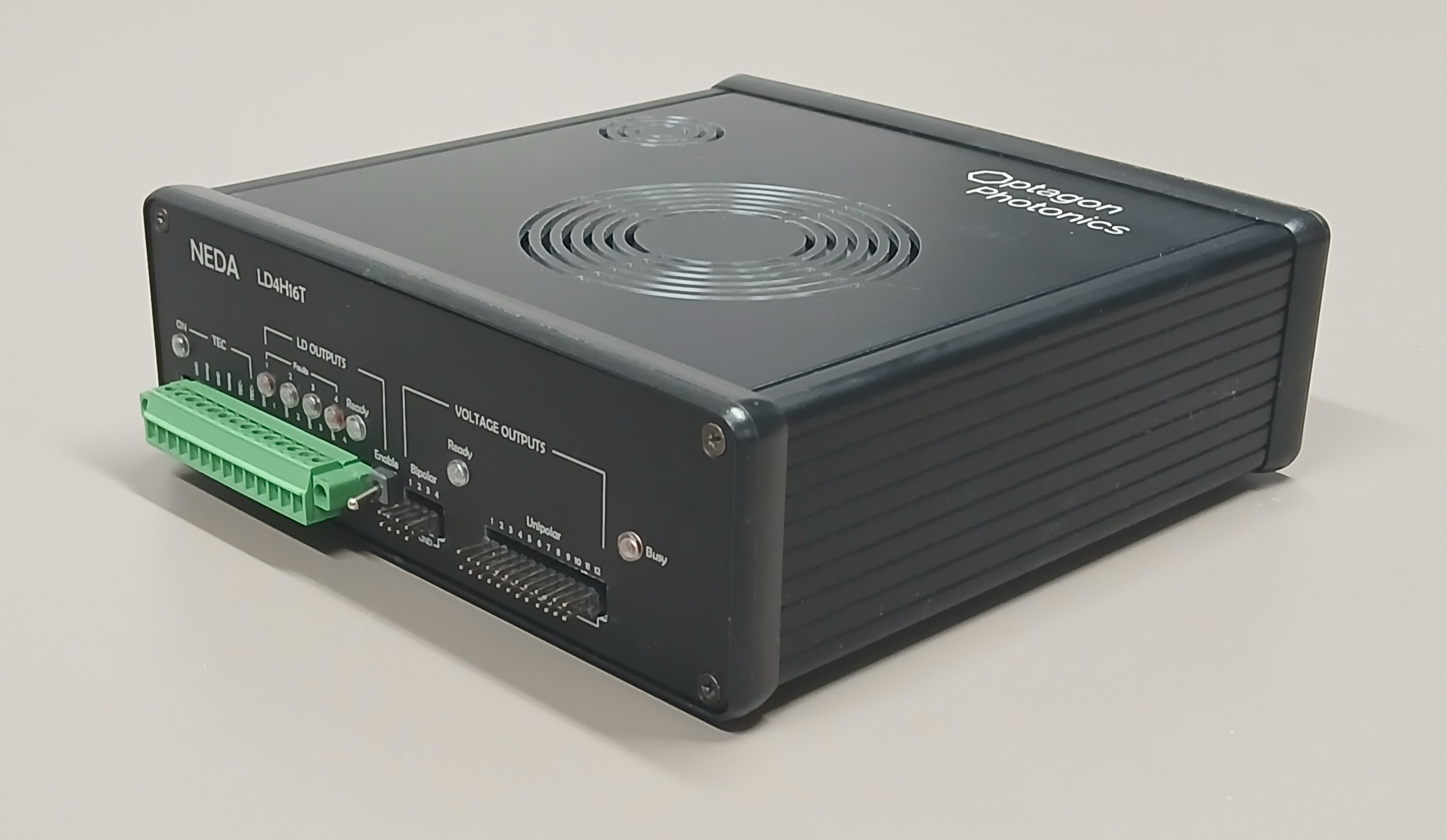
NEDA LD4H16T is our versatile 20-channel controller for optoelectronic components, modules and PICs, being compatible with all mainstream photonic integration platforms. It offers 4 current sources for active elements, 12 unipolar voltage sources for heating electrodes and small capacitive loads, and 4 bipolar voltage sources for biasing purposes. It also incorporates a TEC controller for precise thermal regulation and management. The 4 current sources are based on our core driving engine (see NEDA LD4-A below). NEDA LD4H16T supports low-jitter arbitrary waveform generation at rates up to 2 MSPS across all the unipolar voltage sources, enabling programmability and fast reconfigurability during PIC testing, calibration and operation. The device is controlled by a modern GUI. A Python API is also provided, enabling users to build their own scripts.
Read the datasheet or download the user manual. Info, quotations and orders: sales@optagon-photonics.eu.
Read the datasheet or download the user manual. Info, quotations and orders: sales@optagon-photonics.eu.
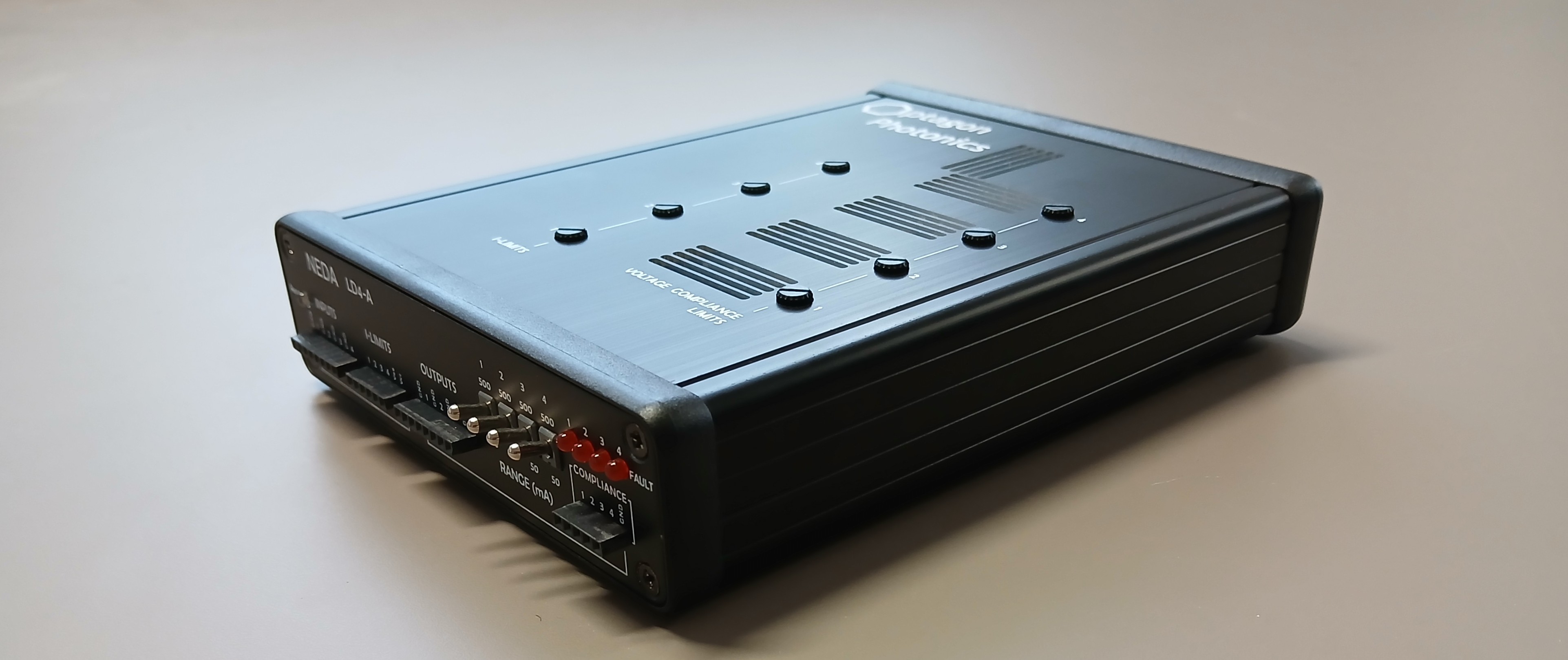
NEDA LD4-A is our powerful 4-channel driving engine for active elements such as laser diodes, superluminescent diodes and semiconductor optical amplifiers, and for low resistance heating electrodes. It incorporates by design all safety features required for operation of sensitive optoelectronic loads, and provides up to 4 V compliance voltage and up to 500 mA output current per channel. The channels form a quad of independent voltage controlled current sources based on a common-cathode architecture that makes our engine ideal as a driving solution for active multi-element chips and PICs.
Read the datasheet and user manual. Information, quotation request and order: sales@optagon-photonics.eu.
Read the datasheet and user manual. Information, quotation request and order: sales@optagon-photonics.eu.
Industrial prototypes
In parallel we are working on a number of ambitious industrial prototypes based on proprietary system concepts and designs for communication and sensing applications.

Optical equalizer: We are working on a photonic integrated optical equalizer that can be used as an add-on unit in optical transmitters for optical interconnects inside data centers and FSO links. The optical equalizer has the flexibility to operate over a broad range of rates up to 100 Gbaud compensating for the bandwidth limitations of the corresponding transmission systems. Multi-channel operation is also supported. Its system design is based on a patent family of Optagon. The preparation of the first prototype was realized in silicon nitride with support from ACTPHAST4.0. Experimental results from the use of the optical equalizer inside optical interconnects have validated its multi-rate and multi-channel operation potential and its overall system design.

Active optical sensor: We are also developing an active optical sensor based on the emission, reflection, detection and analysis of broadband light. The localization of the reflecting objects and the image reconstruction is based on the combination of a time-of-flight (TOF) method with an ultra-fast scanning process on the elevation and azimuthal plane. The potential of this process is empowered by a disruptive optical phased array (OPA) concept formulated and IP protected by Optagon. A working prototype has been designed and fabricated with the help of LioniX International and is currently under lab testing for robotic vision applications.
OFDR engines: We are also working on variants of interrogation engines for optical frequency domain reflectometry (OFDR), optimized for coherent LIDARs and distributed acoustic sensing (DAS) systems. Based on linear frequency modulation schemes and coherent detection, our OFDR engines comprise all required photonic, electronic and software components to support the corresponding applications. Miniaturization of these engines through photonic integration of their optical parts comes next. Stay tuned!